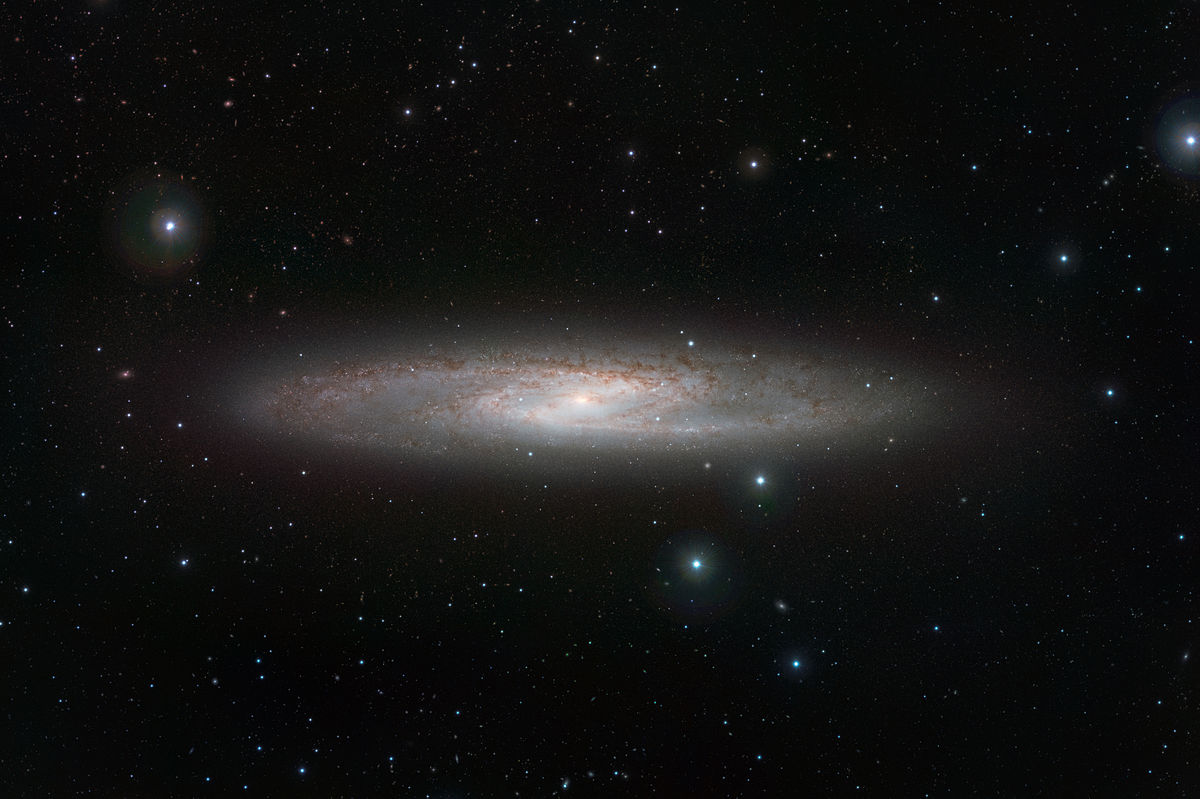
Apart from optical telescopes equipped with their detectors and other spectrographs, to carry out their research, astronomers also need theoretical tools, especially models and statistical functions. Indeed, the problem for an astronomer is not only to be able to observe the objects furthest from the Universe to specify its evolution but especially to be able to determine their parameters and in particular to calculate their distance, their luminosity, their size, and if possible their nature.
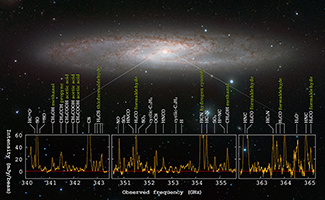
Spectrum of the core of galaxy NGC 253 obtained by ALMA.
The determination of the distance of the galaxies is the obligatory passage to study their physical and statistical properties. We must know it to calculate the luminosity of the galaxies and their linear size which vary as we know according to the distance. It is also necessary to determine the distribution of galaxies in the universe at different times. In short, this famous distance comes in many formulas, statistical functions and models.
At short and medium distances it is easy to calculate this distance by comparison from “standard scales”, standards known for decades as the variability of Cepheids, the brightness of type Ia supernovae, the rotation speed of spiral galaxies ( from the width of the hydrogen line HI to 21 cm), the speed of dispersion of stars in elliptical galaxies or the Hubble relation based on the speed of expansion of the universe, the latter method operating up to 10 billion light-years, actually as far as one can get a spectrum of exploitable galaxy.
But for very distant objects, beyond 13 billion light-years or z ~ 7, all astronomers passionate about the subject recognize that this distance is very difficult to calculate because of the limited scope of current instruments and the very low brightness of these galaxies, sometimes reduced to a few pixels and a “glitch” on the graphics. In addition, a representative sample must be chosen in order not to waste time analyzing nearby bodies or data that would distort the statistical analyzes, while ensuring that the data are not contaminated by various components that must be identified. but may also be faint or less numerous along the line of sight, with the result of a certain margin of error that may exceed 65% for high redshift and very pale galaxies.
Despite these challenges, astronomers, who often have very advanced skills in mathematics, statistics and sometimes programming, have developed very powerful theoretical tools. We will take three concrete examples of tools that have helped them make major discoveries in recent years.
1,422 comments
UAE Warriors 70
For those hoping to earn on homegrown heavyweights who fight with nonstop urgency UAE Warriors 70 serves as your perfect stomping ground.
https://differ.blog/p/desert-heat-and-heavy-stakes-the-forge-of-uae-warriors-70-4ef858
UAE Warriors 70, scheduled for May 8, 2026, at the Space42 Arena in Abu Dhabi serves as a perfect example of this.
https://cialis.sbs/# Tadalafil price
It’s awesome in favor of me to have a web site, which is beneficial in support of my knowledge. thanks admin
在线购买大麻用于XXX成人色情视频
pusulabet resmi giriş [url=https://bestbetgiris.online/#]pusulabet resmi[/url]
pusulabet resmi: pusulabet giris
pusulabet resmi: pusulabet giris
Generic Cialis without a doctor prescription [url=https://cialis.sbs/#]buy cialis pill[/url] Cialis 20mg price in USA
pusulabet [url=https://bestbetgiris.online/#]pusulabet giris[/url]
UFC Medkouri vs Neves
If you look at the advanced stats on GidStats you’ll see that Medkouri is far more efficient with his output and doesn’t gas out the moment he has to wrestle .
Neves enters backed by the full “knockout artist” reputation.