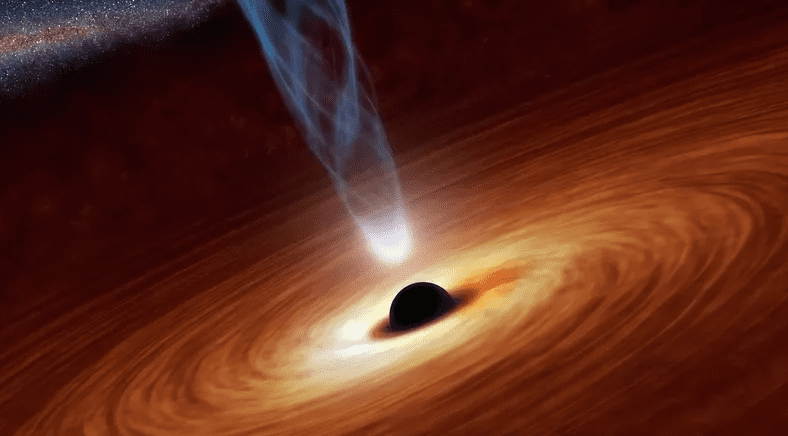
Black holes, the cosmic enigmas that defy the laws of physics, continue to captivate the imaginations of astronomers and enthusiasts alike. These mysterious celestial entities, characterized by their intense gravitational pull, have the power to swallow even light itself. In this article, we will embark on a journey into the depths of black holes, exploring their formation, properties, and the profound impact they have on the fabric of the universe.
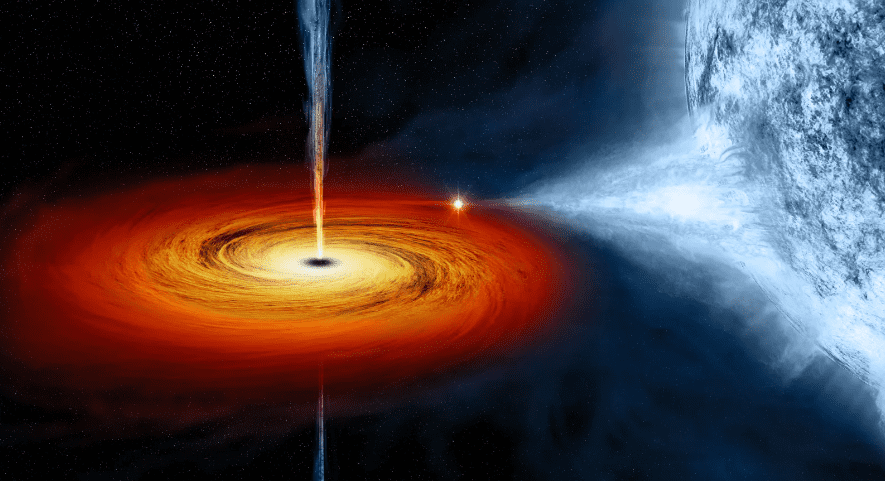
What is a Black Hole?
At its core, a black hole is a region in space where gravity is so incredibly strong that nothing, not even light, can escape its clutches. The point of no return around a black hole is called the event horizon. Once an object crosses this boundary, it is destined to be consumed by the black hole, disappearing from our observable universe.
Formation of Black Holes:
Black holes are born through the death throes of massive stars. When a massive star exhausts its nuclear fuel, it undergoes a supernova explosion, casting off its outer layers into space. What remains is a dense core, and if this core surpasses a critical mass known as the Chandrasekhar limit (about 2.5 times the mass of the sun), gravitational forces become overwhelming. The core collapses under its own gravity, forming a singularity—a point of infinite density at the heart of the black hole.
Types of Black Holes:
There are primarily three types of black holes: stellar black holes, intermediate black holes, and supermassive black holes.
1. **Stellar Black Holes:**
– Formed from the collapse of massive stars, stellar black holes typically have masses ranging from about three to ten times that of the sun.
2. **Intermediate Black Holes:**
– The existence of intermediate black holes with masses between 100 and 1000 times that of the sun is theorized, though observational evidence is still being sought.
3. **Supermassive Black Holes:**
– Found at the centers of most galaxies, including our Milky Way, supermassive black holes have masses ranging from hundreds of thousands to billions of times that of the sun. The exact mechanism of their formation is still a subject of active research.
Properties of Black Holes:
The gravitational force around a black hole is so intense that it warps spacetime itself. This phenomenon is described by Albert Einstein’s theory of general relativity. Time dilation near a black hole causes time to pass more slowly, and extreme gravitational forces distort the path of light, creating gravitational lensing—a phenomenon often used by astronomers to study distant galaxies.
Event Horizon Telescope and the First Image:
In April 2019, the Event Horizon Telescope (EHT) collaboration made headlines by releasing the first-ever image of a black hole. Located in the center of the galaxy M87, the black hole’s shadow against the bright, hot gas swirling around it was captured in unprecedented detail. This monumental achievement marked a significant leap forward in our understanding of black holes and provided visual confirmation of these elusive entities.
Hawking Radiation and Black Hole Thermodynamics:
While black holes are notorious for their voracious appetite, they are not entirely invincible. In the 1970s, physicist Stephen Hawking proposed the existence of Hawking radiation, a theoretical process through which black holes can gradually lose mass and energy over time. This phenomenon suggests that black holes are not eternal, challenging the once-held belief that nothing could escape their gravitational grip.
The Information Paradox:
The nature of what happens to the information of particles that fall into a black hole remains one of the most perplexing puzzles in theoretical physics—the information paradox. According to the principles of quantum mechanics, information is never lost, but when it comes to black holes, reconciling quantum mechanics with general relativity poses a profound challenge.
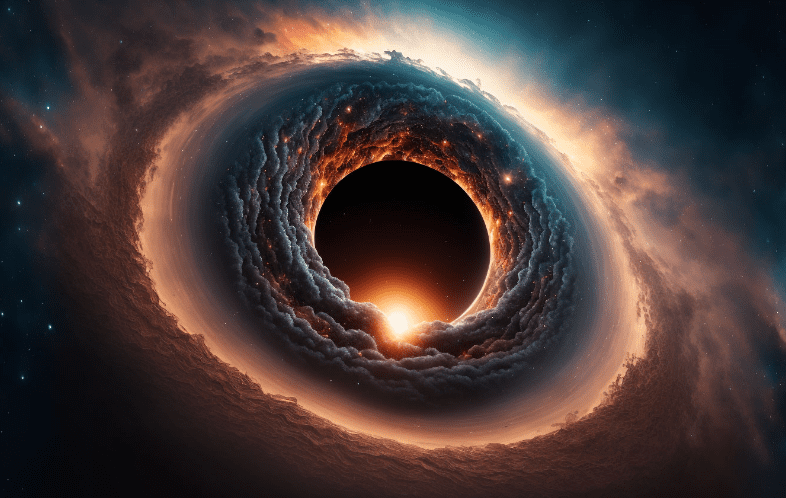
Black holes, with their inscrutable properties and gravitational dominance, stand as some of the most intriguing and mysterious objects in the cosmos. As our understanding of these cosmic enigmas continues to evolve, new questions arise, pushing the boundaries of our knowledge. The exploration of black holes not only deepens our comprehension of fundamental physics but also sparks the imagination, inviting us to contemplate the profound mysteries that lie at the heart of our vast and wondrous universe.
3,979 comments
online mexican pharmacy: mexico pharmacy – mexican pharmacy online
mexican pharmacy: mexican online pharmacy – mexican pharmacy online
https://northbridgepharm.shop/# online canadian pharmacy
india online pharmacy: india pharmacy – overseas pharmacy no prescription
http://northbridgepharm.com/# online canadian pharmacy
mexican pharmacy online: mexican online pharmacy – online mexican pharmacy
world pharmacy india HealthSphere Pharmacy top online pharmacy
mexico pharmacy mexican online pharmacy mexico pharmacy
https://healthspherepharmacy.shop/# buy medicines online in india
https://healthspherepharmacy.com/# reputable indian online pharmacy