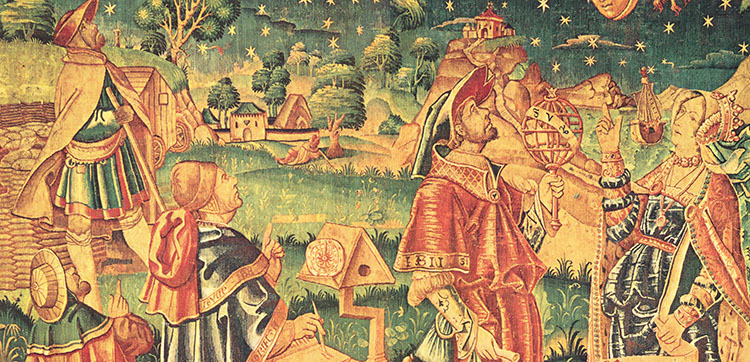
Astronomy goes back thousands of years. It is likely that it originated in prehistoric times when our ancestors wondered about their future and the forces of nature, engraving the first symbols on stone or bone and painting the walls of caves.
The first astronomical measurements date back to around 6700 years ago, when the first alignments of menhirs are found north of Carnac in Morbihan, France. They will be followed by the Stonehenge stones erected in England that dates back to 4600 years ago.
Astronomy was already a science in Mesopotamia 4300 years ago. In fact, we have discovered in the present Iraq the first records concerning the observation of lunar eclipses, comets, as well as the first predictions of the conjunctions of the planets between them.
Thus, more than 2000 years ago, in the year 7 BC, Babylonian astronomers predicted the conjunction of Jupiter with Saturn in Pisces. Another more brilliant conjunction, this time between Jupiter and Venus, was observed in the year -2.
According to recent computer simulations, it is perhaps one of these events that was at the origin of the “star of the Magi”.
One thing is almost certain, this phenomenon guided three Magi in Palestine, Nazareth, where was born a certain … Jesus. We will come back to it.
But it is to the Greek philosophers like Plato, Aristotle, Thales or Pythagoras that we owe the foundations of astronomy. These great thinkers considered that symmetry, order, reigned in nature.
However, these general laws were not based on experience but only on reflection, theory. They offered no certainty since they never tried to prove what they said. That’s why a lot of their ideas turned out to be wrong afterwards. That said we believed for centuries before proving they were wrong.
About 500 years before our era, the number 0 was invented in India. Thanks to this figure, the Indians were the inventors of the largest numbers that can be conceived.
Around 146 BC, the Greek astronomer and mathematician Hipparchus of Nicaea visually measured the position of a thousand stars and recalculated the distance of the Sun and the Moon. It is also Hipparchus who discovered the precession of the equinoxes, the slow drift of the axis of rotation of the Earth, which in turn gives the place of a polar star to different stars by comparing the sidereal rotation of the Sun with its tropical rotation. .
314 comments
https://canadexiarx.com/# canadian pharmacy website
generic medicines online india: buy generic drugs from india – generic medicines online india
best online pharmacies in mexico: mexican pharmacy online us shipping – pharmacies in mexico that ship to usa
https://canadexiarx.com/# canadian pharmacies
reputable canadian online pharmacy: certified canadian pharmacy online – canada pharmacy
online medicine websites: DeccanBatchRx – indian pharmacies in usa
https://canadexiarx.com/# canadian pharmacies that deliver to the us
https://canadexiarx.com/# certified canadian international pharmacy
farmacia mexicana en linea: online drugs order – buying from online mexican pharmacy
online mexico pharmacy usa: cheap mexican rx mail order – mexican pharmacy for hair loss pills