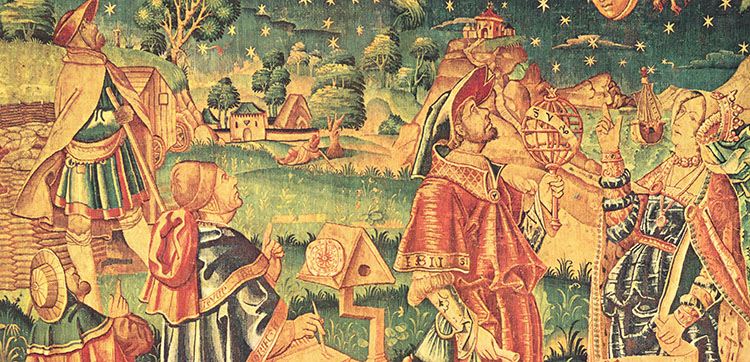
Astronomy goes back thousands of years. It is likely that it originated in prehistoric times when our ancestors wondered about their future and the forces of nature, engraving the first symbols on stone or bone and painting the walls of caves.
The first astronomical measurements date back to around 6700 years ago, when the first alignments of menhirs are found north of Carnac in Morbihan, France. They will be followed by the Stonehenge stones erected in England that dates back to 4600 years ago.
Astronomy was already a science in Mesopotamia 4300 years ago. In fact, we have discovered in the present Iraq the first records concerning the observation of lunar eclipses, comets, as well as the first predictions of the conjunctions of the planets between them.
Thus, more than 2000 years ago, in the year 7 BC, Babylonian astronomers predicted the conjunction of Jupiter with Saturn in Pisces. Another more brilliant conjunction, this time between Jupiter and Venus, was observed in the year -2.
According to recent computer simulations, it is perhaps one of these events that was at the origin of the “star of the Magi”.
One thing is almost certain, this phenomenon guided three Magi in Palestine, Nazareth, where was born a certain … Jesus. We will come back to it.
But it is to the Greek philosophers like Plato, Aristotle, Thales or Pythagoras that we owe the foundations of astronomy. These great thinkers considered that symmetry, order, reigned in nature.
However, these general laws were not based on experience but only on reflection, theory. They offered no certainty since they never tried to prove what they said. That’s why a lot of their ideas turned out to be wrong afterwards. That said we believed for centuries before proving they were wrong.
About 500 years before our era, the number 0 was invented in India. Thanks to this figure, the Indians were the inventors of the largest numbers that can be conceived.
Around 146 BC, the Greek astronomer and mathematician Hipparchus of Nicaea visually measured the position of a thousand stars and recalculated the distance of the Sun and the Moon. It is also Hipparchus who discovered the precession of the equinoxes, the slow drift of the axis of rotation of the Earth, which in turn gives the place of a polar star to different stars by comparing the sidereal rotation of the Sun with its tropical rotation. .
3,875 comments
pet meds official website: vet pharmacy online – pet meds for dogs
online pharmacy without prescription http://edmedscoupon.com/# buy ed pills online
best mail order pharmacy: Pharm Rate – new pharmacy online
stromectol how much it cost: ivermectin 500ml – ivermectin cream 1%
https://semaglutide.life/# rybelsus farmacia guadalajara
stromectol reviews: stromectol reviews – buy ivermectin canada
https://semaglutide.life/# rybelsus 14 mg precio
get antibiotics quickly: over the counter antibiotics – buy antibiotics from india
https://semaglutide.life/# can rybelsus cause pancreatitis
https://antibiotics.cheap/# over the counter antibiotics