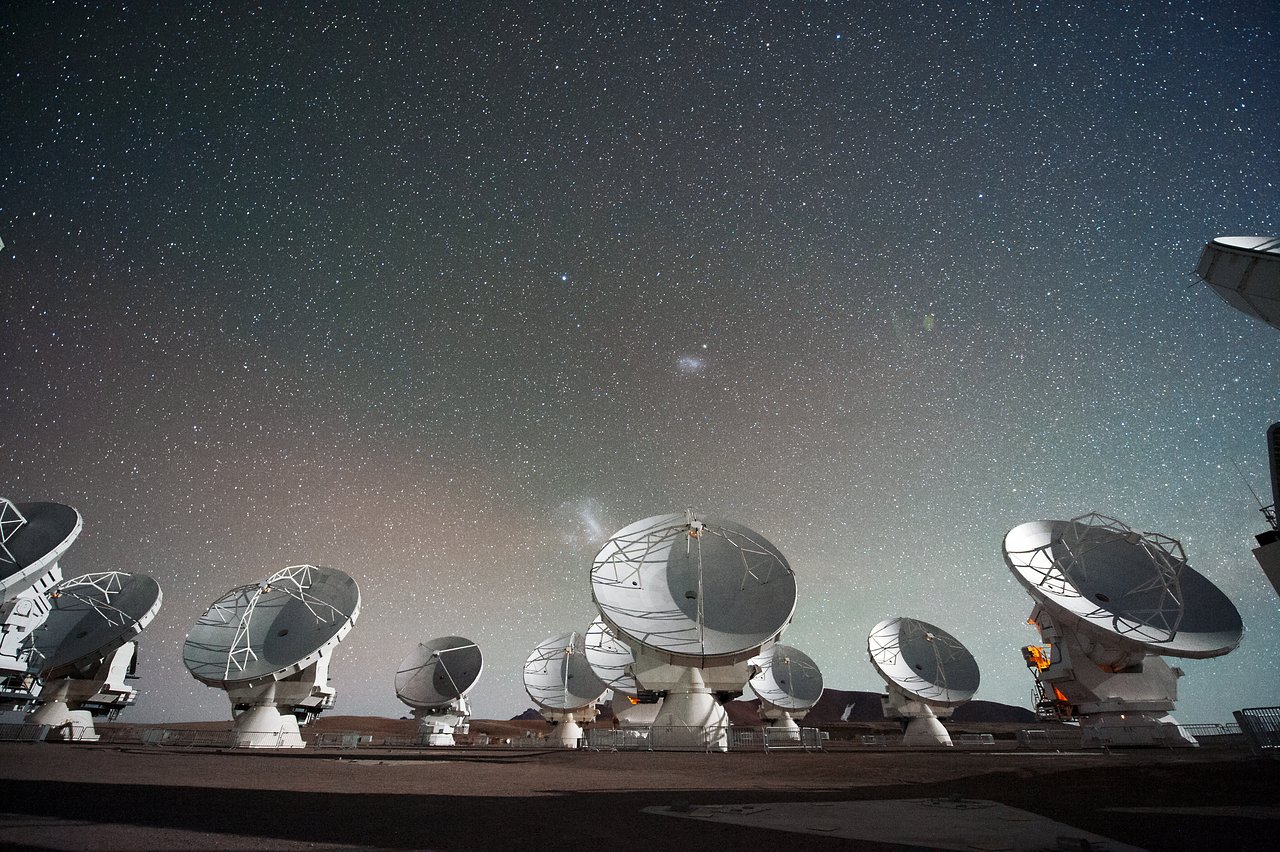
Several large facilities are now operational in the milli and submillimetric bands. There is ALMA (Atacama Large Millimeter / submillimeter Array) installed in Chile. It is an international project (Europe, United States and Japan), each member country participating in the construction and management of its own antennas.
Started in 2003 at the same time as the decommissioning of ESO’s 15 m SEST satellite dish, the ALMA network now includes 66 radio telescopes whose parabolas measure between 12 m and 7 m in diameter and work between 0.32-3.6 mm or between 936-83 GHz. The base can reach 16 km in length. It is the most powerful radioastronomy facility in the world. It reaches the resolution of a spatial VLBI of 0.0001 “or 0.1 mas at 850 microns or 345 GHz for a base of 10 km and an SNR = 30, which is not yet an optimized value.
ALMA was inaugurated in 2014 and cost $ 1.4 billion, including $ 5 million per antenna. By spreading this cost among the 1.1 billion inhabitants of the participating countries and broken down over its lifetime beyond a century, each European and American citizen contributes $ 1.2 / year or € 1 / year. $ 0.2 / yr or 30 yen / yr.
We will see in the records on astrophysics and cosmology that ALMA has to his credit important discoveries concerning the dynamics of primordial galaxies, Lyman-alpha emitters, quasars, black holes and protoplanetary disks among many other discoveries.
The second major facility is the CfA’s submarine beam array (SMA) in Hawaii, practically at the top of Mauna Kea (Pu’u Poli’ahu) at 4080 m altitude and has been operational since 1998. It has 8 parables 6 m in diameter work between 0.3 and 1.7 mm (999-42 GHz but limited between 700-180 GHz in practice) and the base can reach 509 meters.
Other radio astronomical observatories used in the millimetric bands to study both stellar (protostar) sites and the molecular components and properties of the more distant galaxies or pulsars include the well-known 100 m diameter GBT radio telescope at Green Bank West Virginia presented below from different angles.
With its 100×110 m diameter parabola, the GBT is the largest orientable radio-telescope. Since 2004, he replaces the Green Bank branch which collapsed in 1988, thankfully without victim. The GBT is 145 m high, its disc is 100×110 m in diameter and the installation weighs 8500 tons. His parable consists of 2004 moving panels managed by 2209 actuators that maintain its curvature to near 76 microns (RMS). In general, the movements of the panels do not exceed a few centimeters according to the astronomer D.J.Pisano of the University of West Virginia who uses the GBT to study the clouds of hydrogen. The GBT operates between 100 MHz and 116 GHz (and more generally between 290 MHz and 1 GHz) and has a gain of 51 dB at 432 MHz!
2,173 comments
rybelsus semaglutide tablets switching from mounjaro to semaglutide reputable overseas online pharmacies
Cialis without a doctor prescription Cheap Cialis Buy Tadalafil 20mg
Tadalafil price Generic Tadalafil 20mg price Buy Tadalafil 20mg
Tadalafil Tablet Generic Cialis price Cheap Cialis
https://rybelsus.pro/# rybelsus near me
Sildenafil 100mg price Buy generic 100mg Viagra online buy viagra here
cheap viagra buy Viagra online Buy Viagra online cheap
https://viagra.onl/# Cheap generic Viagra
https://rybelsus.pro/# rybelsus 14 mg coupon
Order Viagra 50 mg online Cheap Viagra 100mg generic sildenafil