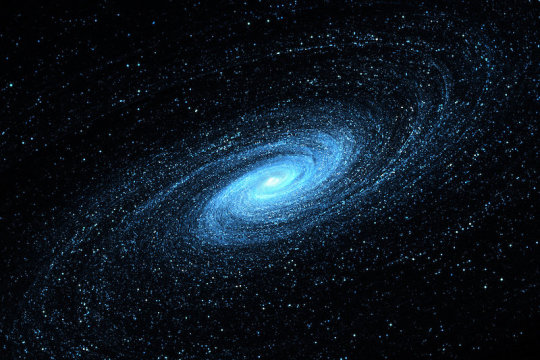
Our Galaxy forms a disc a little thicker in the center that is observed in profile, which is why the Milky Way seems very long and quite thin. The stars are concentrated in the central part located in the constellation Sagittarius. It is the widest and brightest region.
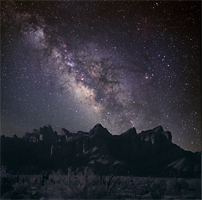
Paradoxically it is also the most opaque region of the Milky Way because it contains a lot of dust that hides the light of the stars in the background; these are all the dark stripes that you see in the middle of the picture below. At the ends, near the constellations of the Coachman (Auriga) and Gemini (Gemini), it dissipates and can hardly be seen with the naked eye among the nearby stars.
 Thanks to radio astronomy and infrared telescopes that can cross dark clouds of dust to observe the other side of the Milky Way, almost all of its shape has been determined. Thus it was discovered that our galaxy had several very tight spiral arms that wrapped around the nucleus. She is escorted by two satellite galaxies, the two Magellanic Clouds visible in the Southern Hemisphere, a little away from the Milky Way.
Our galaxy, with a large “G” to distinguish it from other galaxies, is similar to the billions of other galaxies that populate the universe. We will come back to this in the next chapter.
The Milky Way is one of the largest and most massive galaxies, containing between 200 and 400 billion stars similar to the Sun. Some are younger and are located in the bluish spiral arms where a lot of gas has accumulated, the others are much older than the Sun and are concentrated in the core which has a yellow-orange color. These stars are so close to each other in the heart of the Milky Way that it is impossible to count them!
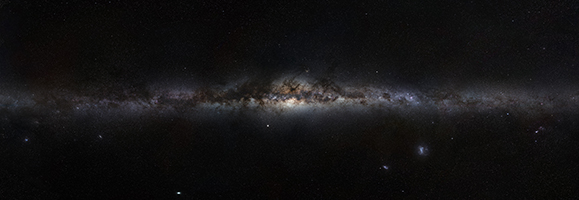
The Milky Way seen in profile. Our Galaxy is about 120,000 light years in diameter and contains between 200 and 400 billion stars. Its total mass reaches 700 to 850 billion times that of the Sun, as much as the galaxy of Andromeda.
The Milky Way is very large and it is quite difficult to imagine its dimensions: it is about 120,000 light-years in diameter. The Sun is about 25,000 light-years from the center in an area about 700 light-years thick. The Milky Way turns slightly on itself but it is so big that the Sun and the planets take about 250 million years to go around.
All the stars that you see in the sky belong to the Milky Way. They are located near the Sun, at most a few thousand light-years away. The nearest star is Proxima Centauri. It is 4.3 light years away.
93,681 comments
купить курсовую москва купить курсовую москва .
курсовая работа на заказ цена курсовая работа на заказ цена .
заказать курсовую работу спб kupit-kursovuyu-44.ru .
написание курсовой на заказ цена kupit-kursovuyu-42.ru .
раскрутка и продвижение сайта раскрутка и продвижение сайта .
продвижение сайтов продвижение сайтов .
купить курсовую сайт kupit-kursovuyu-45.ru .
написание курсовой работы на заказ цена kupit-kursovuyu-43.ru .
This information is priceless. Where can I find out more?
курсовая работа на заказ цена курсовая работа на заказ цена .