When you see the size of small astronomical instruments sold in specialty stores, they only impress novices. On the other hand, a telescope of 200 mm in diameter measuring between 1.5 and 2 m in height like the one presented above on the left intimidates already an amateur informed by its proportions and the quality of its images.
So imagine a telescope 1.5 m to 1.8 m opening as some amateurs have built (see the article on Dobson telescopes). It is disproportionate and very impressive. It is even more so when we know that despite a weight greater than 100 kg we can handle it alone. Whoever has the chance to observe the sky with the eyepiece of such a giant remembers all his life so the show is dazzling, in every sense of the term (see these images of Jupiter and M13 taken to through telescopes of different diameters).
Now imagine a telescope housed under a tall dome like a building! As we see below, at the end of the 19th century the optician engineers did not hesitate to make giant astronomical glasses whose objective measured 83 cm in diameter (Observatoire de Paris), 91 cm (Lick Observatory ) and even the record 102 cm in diameter (Yerkes Observatory). Some of them are still used, certainly more to observe or photograph the deep sky but especially to study the suburbs of the Milky Way and nearby objects such as asteroids.
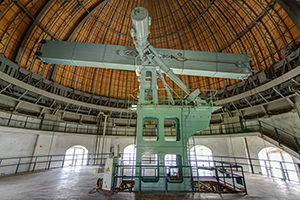
Because of their location often close to major cities and their limited separating power, today these large astronomical glasses of other age are relegated to additional tasks in favor of large telescopes mirror. In California, some 80 km south of Pasadena is one of the most prestigious telescopes in the world, which for a long time remained unrivaled: the 5-meter diameter Hale telescope on Mount Palomar. This very impressive instrument makes it possible to explore the depths of the Universe with such a resolution that it served as a model for the largest telescopes of today: the BTA-6, Magellan and MMT (~ 6 m in diameter), the VLTs, Gemini and Subaru (~ 8 m diameter), Keck (9.8 m diameter) and GTC (10.4 m diameter), and telescopes four times larger in a few years!
But a sign of progress and of necessity, for more than half a century, no astronomer has any more eyes on the eyepiece of these giant telescopes, which in any case are not equipped for this purpose, the large CCD sensor like a suitcase that has replaced the eyepiece for a few decades now. Only telescopes 1 to 2 m in diameter and large astronomical glasses over one meter in diameter are still equipped with an eyepiece and a guide bezel. But their use becomes anecdotal.
5,926 comments
orlistat https://usobesityscience.org/orlistat-clinical-review/ semaglutide peptide
true fortune 50 free spins true fortune 50 free spins .
true fortune casino free spins true fortune casino free spins .
how much weight can you lose on rybelsus in a month orlistat
semaglutide https://usobesityscience.org/semaglutide-research/ liraglutide online
liraglutide pharmacy liraglutide
Advancing Clinical Research in Metabolic Health and Weight Management https://usobesityscience.org/liraglutide-studies/ rybelsus patient assistance
FIFA世界杯
2026 年世界盃 將會由 48 支球隊 參與本屆賽事,本屆賽事將分成 12 個小組,每組 4 隊。各組前兩名 可晉級 淘汰賽階段,進行 16 強至決賽的淘汰賽程。
這屆 FIFA 世界盃 將於 2026 年 6 月 正式開賽。首場比賽 預計由 墨西哥迎戰南非,於 6 月 12 日 在 Estadio Azteca 舉辦。同日稍晚,南韓將迎戰捷克。翌日,加拿大對波士尼亞,以及美國對巴拉圭等小組賽首輪賽事將登場。
小組賽方面,A 組 由 墨西哥、南非、南韓與捷克;B 組 則由 加拿大、波士尼亞、卡達以及瑞士;C 組 包含 巴西、摩洛哥、海地及蘇格蘭構成。像是 巴西、法國、阿根廷、西班牙、英格蘭與德國等傳統強隊 皆已完成分組。
淘汰賽 預計於 7 月初 正式進行,16 強賽 將於 7 月 4 日 登場,而冠軍戰預定於 7 月 19 日 進行,屆時將決定 2026 年 FIFA 世界盃冠軍。
歷史對戰方面,墨西哥過去曾與南非於 2010 年世界盃 對決,當時雙方以 1 比 1 握手言和,雙方仍無勝場差距。
同時,越位、黃牌、紅牌、VAR 與點球等規則,仍是球迷觀賽時的重要基礎知識,相關討論熱度不減。
rybelsus 14 mg precio orlistat
true fortune casino no deposit code true fortune casino no deposit code .