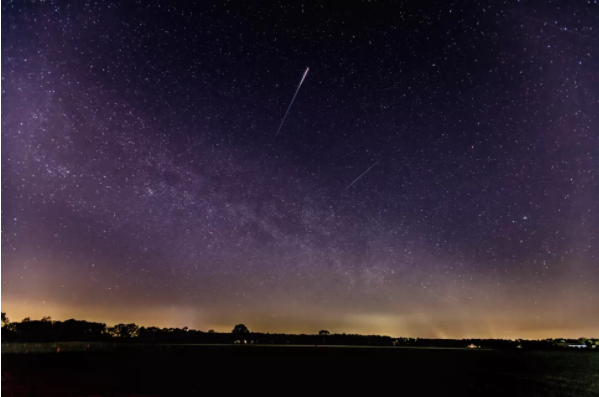
Like any subjective measurement and sometimes taking into account the large number of inexperienced observers who send observation reports to the centralizing body, it is necessary to draw a distribution diagram of the magnitudes specific to each observer in order to be able to make comparisons and detect personal errors.
Estimating magnitudes is often felt by beginners to be a difficult experience and the differences for each observer are clearly shown in the charts of the Dutch Meteor Society.
A beginner finds it difficult to estimate the magnitude of the brightest meteors that are not rated uniformly. It is a normal phenomenon for an inexperienced observer that one finds in the evaluation of variable stars.
The errors become larger and larger as the brightness of meteors increases and exceeds magnitude 0 due to the fact that there are fewer comparison stars. Conversely, novice observers often underestimate very faint meteors. It is a logical error by a very starry sky which leads to give to the population index “r” too high a value (r = 3).
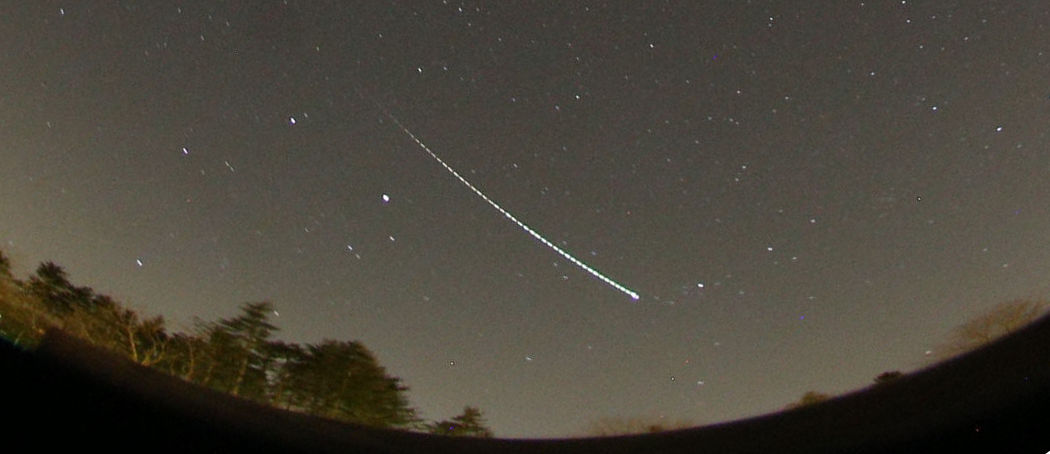
Finally, we can observe breaks between certain magnitudes (between 2 and 4 for example) which are often produced by overly optimistic evaluations of observations made under bad conditions and pessimistic evaluations made under good conditions. This model applies not only to swarms but also to the observation of sporadic meteors.
As a general rule, we can deduce that at least there are meteors for a given magnitude, the greater the ascending line running through the points found. The angle that this straight line forms with the magnitude axis represents the average lumination value for this swarm, conditioned by the factor “r”, the population index. The smaller this factor, the greater the average lumination. This must be taken into account because the more an observer estimates the intense luminosity, the smaller “r” will be. The circumstances of the observation therefore play an important role.
It is important that observers become aware of their “personal equation” in order to deduce the main differences between their own evaluations and the mean and take them into account in their next observations. In the long term, we can also consider attributing to each assiduous and confirmed observer a determined correction factor, like what is done for the study of Transient Lunar Phenomena.
But from this simple graph we cannot yet deduce the individual correction factors. For this, the observer must have noted a large number of meteors during his observation session. In addition, the limiting magnitude per observation station probably plays a disturbing role. An analysis of the factors influencing the estimation of luminosity was undertaken by the British Meteor Society a few years ago (Robert Mackenzie).
4,735 comments
mexico drug store: affordable border pharmacy mexico – pharmacy in mexico city
https://certifiedmaplerx.com/# canadian medication delivery to usa
mexican drug stores: mexico border medications usa access – BorderValue RX
canadian medication delivery to usa: canadian medication delivery to usa – reliable canadian pharmacy
mexican drugstore shipping to usa BorderValueRX mexican drugstore shipping to usa
canadian pharmacy near me: certified canadian pharmacy usa – best canadian online pharmacy reviews
farmacia online usa: BorderValueRX – BorderValue RX
http://bordervaluerx.com/# BorderValueRX
trustworthy canadian pharmacy: top 10 pharmacies in india – canada cloud pharmacy
BorderValue RX: mexican pharmacy las vegas – affordable border pharmacy mexico