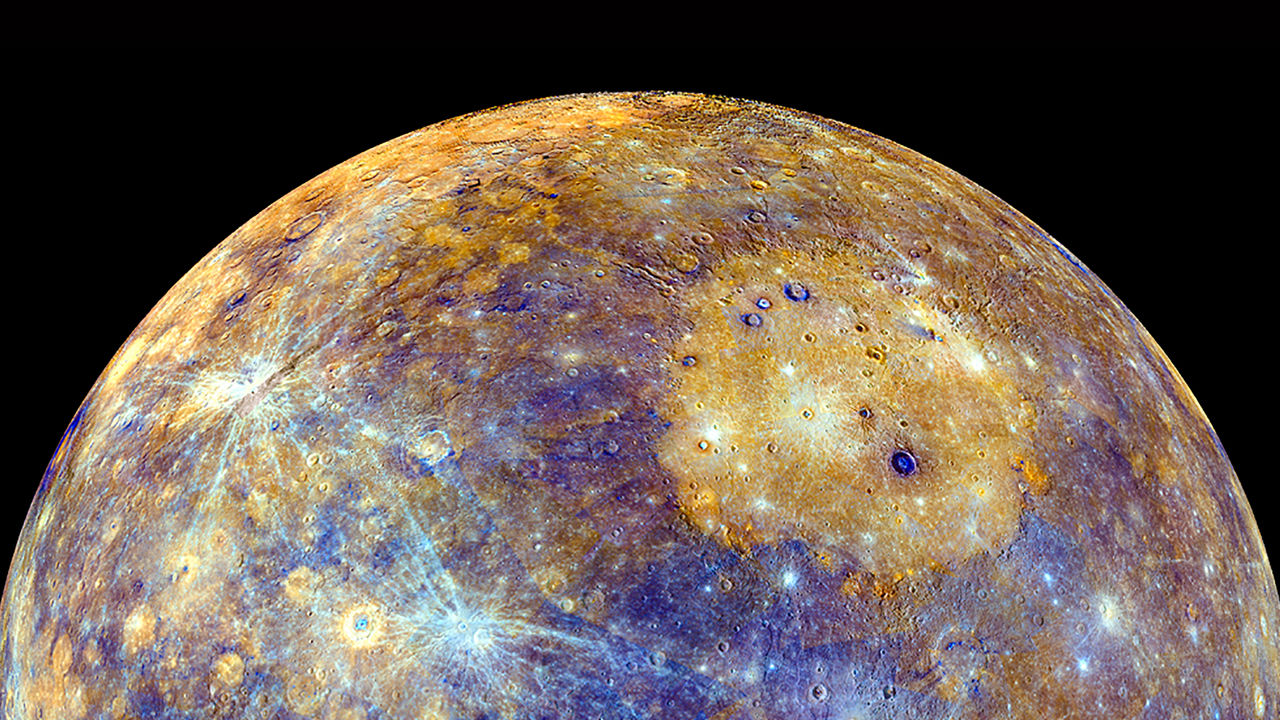
Mercury is the closest planet to the Sun. It orbits 58 million kilometers from the Sun, 2.7 times closer than the Earth and named “Swift Planet” because of it’s swiftness around the Sun.
Mercury is a small planet that resembles the Moon with a diameter of 4878 km (against 12756 km for the Earth). Mercury does not have an atmosphere. Because of this and being close to the Sun, at noon against the Sun, the average ground temperature is 169°C but can locally reach 430°C, higher than that of a full power oven, while on the dark side the temperature dives between -170 and -193°C, more icy than in Antarctica!
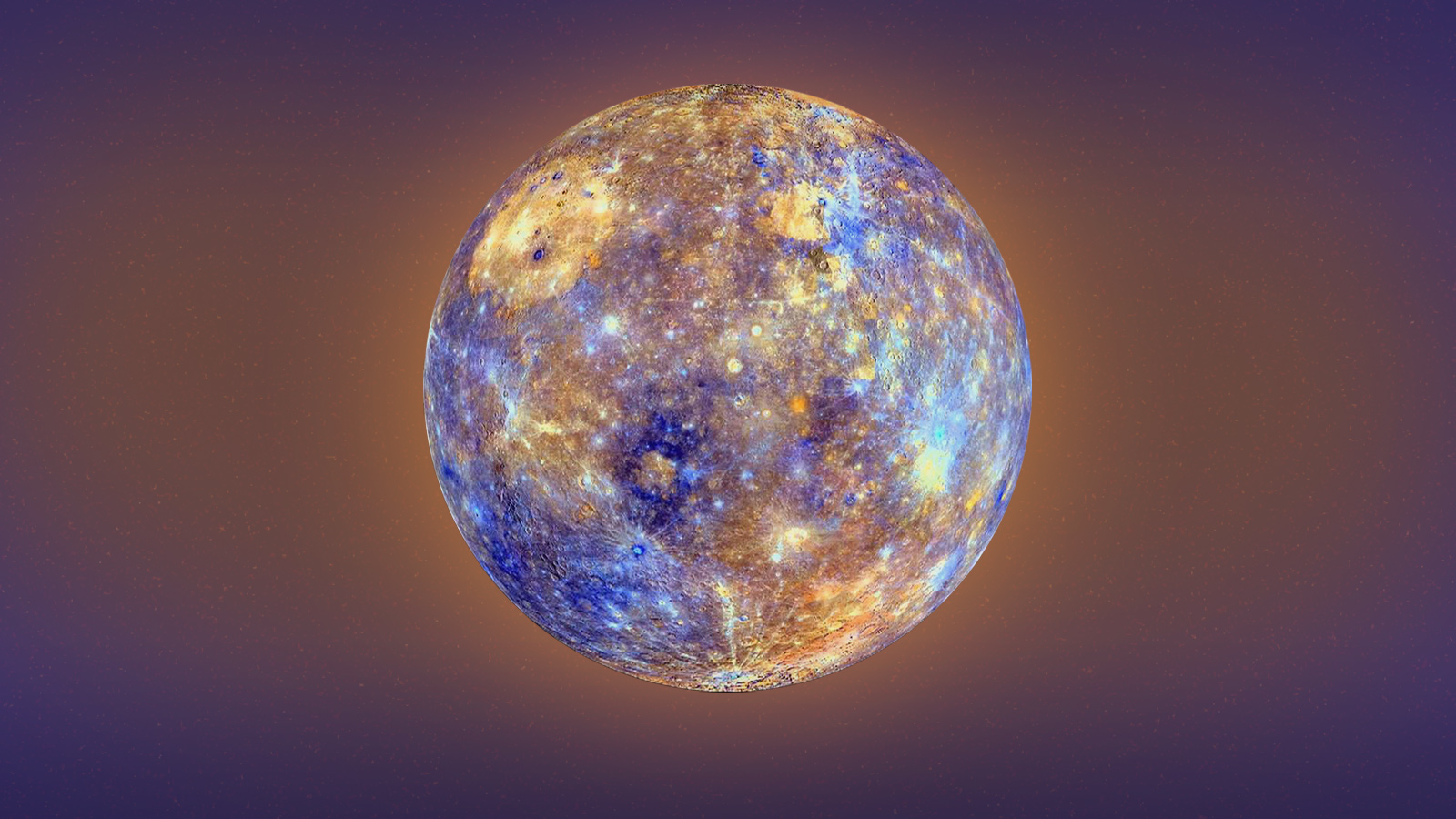
Its surface is covered with craters, mountain ranges and fractures. On Mercury we find the same formations as on the Moon, the same “ray” craters composed of debris or having a central peak, young craters and other very old ones, often covered by other craters. The largest mountains peak at about 3000 m while the faults can extend for 550 km.
The surface of Mercury contains only two large formations: the Rembrandt crater, which measures 700 km in diameter, and the Caloris basin, which stretches over 1300 km. Otherwise, the average crater size is less than 20 km.
Being very close to the Sun, Mercury goes around the Sun in 88 days (against 365.25 days for the Earth) and turns on itself in 58.6 days. In other words, combined with its rotation around the Sun, if a cosmonaut went on Mercury equipped with a special suit protecting him from the heat, he would find that the days last twice as long as the year, ie 176 days against 24 hours on earth !
Like Venus, during inferior conjunctions, that is, when Mercury is near the point closest to Earth’s orbit, it can occasionally cross the Sun’s disk. This event is called a transit. They occur every 6 to 10 years.
The last transits of Mercury in front of the Sun occurred on November 8, 2006 and May 9, 2016. The next transits will take place on November 11, 2019 and November 13, 2032.
Finally, like Venus, since it is close enough to Earth, Mercury appears as a bright star in the morning sky or in the evening near the eastern (morning) or western (evening) horizon. While being brighter than the stars, it remains less brilliant than Venus and one can easily observe its disc more or less round or crescent-shaped in an astronomical telescope or a small telescope.
1,255 comments
http://medmennews.com/# Cheapest Sildenafil online
Viagra without a doctor prescription Canada
viagra canada Med Men News Viagra online price
over the counter sildenafil: Cheap Viagra 100mg – Cheap generic Viagra online
http://medmennews.com/# Buy Viagra online cheap
Sildenafil 100mg price
buy viagra here buy Viagra online buy Viagra online
http://medmennews.com/# MedMenNews
Cheap generic Viagra
buy Viagra online: Buy Viagra online cheap – Cheap generic Viagra online
Sildenafil 100mg price MedMenNews Viagra online price
Viagra online price MedMenNews viagra canada
Buy generic 100mg Viagra online: Med Men News – over the counter sildenafil