At the same time, Galileo turned his “optical tube” to the sky and invented the telescope. She was growing 30 times. He improved the definition of the movement of bodies in space, developing the concept of inertia. This notion allowed him to explain the movement of a mass in the field of gravity. Though a follower of Aristotle’s natural philosophy, he considered that bodies were not naturally at rest.
In his eyes, rest was not the end of the movement. The bodies were at rest only in relation to other animated bodies of the same speed.
But Galileo could not explain the fundamental reason for the movement of bodies and the relative displacement of objects. He explained the changes in positions as the result of an “efficient” cause, an idea faithful to the school of Aristotle.
By observing the phases of Venus and the other planets Galileo managed to confirm the heliocentric system of Copernicus. He discovered the sunspots, the satellites of Jupiter, the relief of the Moon and the fact that the Milky Way consisted of myriads of stars. But as everyone knows, his discoveries were against the doctrine of the Church and led Galileo before the Inquisition … [11]
In his Paradise Lost, John Milton [12] who lived in Galileo’s day, translated the impression that every observer feels when he observes the sky for the first time through a telescope: “Before their eyes suddenly appear the secrets from the old Abyss, a dark, boundless, dimensionless ocean, where length, breadth and depth, time and space are lost. ” The effect that Galileo’s telescope has on his contemporaries is a wonderful reflection of the sensations we experience in our turn, when this reality is separated from its subject by a temporal chasm of more than three centuries.

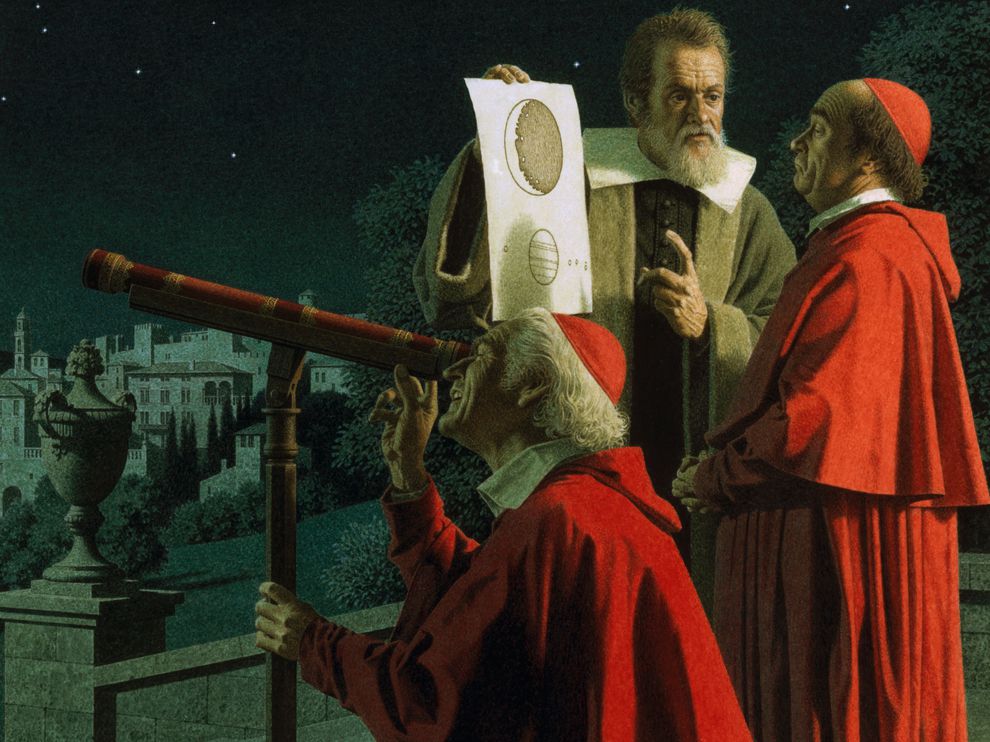
On the left and in the center, Galileo pacing the sky and its famous astronomical telescope exposed to the Museo Galileo. On the right, Galileo explaining his discoveries to two cardinals. Gouache painting on 26×22.9 cm paper made by Belgian illustrator Jean-Léon Huens commissioned by the National Geographic Society for its May 1974 edition.
2,302 comments
thank you very much
thanks
there is no usefull coment in my mind
really helpfull yet still looking forward to see antoher post like this. thank you sir !
.
mmn
212
Nice
good
hi