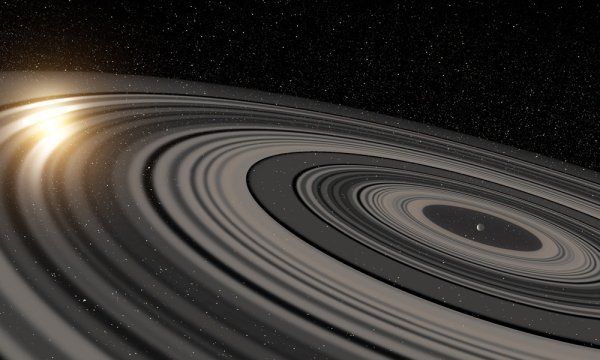
We speak of a system because there is not only one ring but countless, almost an infinity. The rings of Saturn are unique in the solar system because they are both very extended and very bright. From the Earth it seems that there is only one ring smooth and compact. In reality, like those of Jupiter, these rings do not form a compact and united surface. It is pebbles of all sizes and frozen gathered under the effect of gravity. It is even probable that by traveling very slowly we can cross the rings without accident. That said, it’s an experience that astronauts would never do except in a simulation program or at the cinema!
Depending on their brightness, the rings were divided into different parts, from the outside to the inside: the ring A; ring B, the brightest; the darkest C ring and the D ring that almost touches Saturn’s upper atmosphere.
It is not known exactly how the rings formed. They may be the residue of a two-star or moon collision that never formed. One thing is for sure, in the place where they are no satellites cannot keep up because Saturn’s attraction would destroy it and it would scatter around Saturn just forming a ring.

Saturn bending over its orbit, its rings are also inclined 26.7 ° to the orbital plane of the planet. Turning around the Sun in 29 years and a half, every 15 years or so the rings pass in the plane of Earth’s orbit and since they are then aligned with the Earth, they become invisible for a few months.
Although they are very large (650000 km from one end to the other) all of a sudden Saturn loses its ring and even in a large telescope we do not see them so much they are thin: 1.3 km thick! If you represent the ring in small, they are not thicker than a sheet of cigarette paper!
On the left image taken by the Hubble Space Telescope, we can observe the gradual opening of the rings between 1996 (bottom) and 2001 (top).
Of the 62 satellites and some that revolve around Saturn, Titan is the most interesting and is visible as a small bright spot in a small telescope. It is covered with an orange atmosphere consisting of 80% nitrogen, a little argon and methane. It would hide methane lakes in which or on the edges of which astronomers hope to find traces of primitive life. But it is not certain because it is -179 ° C on the ground of Titan … and in principle no body could survive in this cold. All that one could possibly find there are organic molecules more or less complex. If we find better than that (a very primitive form of life), it will be fantastic. But to know it, you have to go back to Titan and it’s not planned for the program before long.
13,352 comments
buy Viagra online [url=http://medmennews.com/#]best price for viagra 100mg[/url] sildenafil online
over the counter sildenafil: MedMenNews – Generic Viagra for sale
Sildenafil Citrate Tablets 100mg: Med Men News – Sildenafil 100mg price
buy Viagra online: sildenafil 50 mg price – Cheapest Sildenafil online
дэдди казино официальный сайт
buy Viagra online [url=https://medmennews.com/#]Cheapest Sildenafil online[/url] Generic Viagra online
Hey friends, I’m putting together a backpacking trip across Europe and looking to find out if flying out of Zagreb offers many budget flight options to major EU cities like Berlin, Barcelona, or Amsterdam. [url=https://directflightdeals.top]cheap flights from amsterdam[/url] My rough travel dates are late August to early September. I’ve reviewed a few sites, but it’s a bit hard to tell if Zagreb’s prices really rival nearby airports like Vienna or Budapest. I came across this publicly reviewed list of airlines servicing Zagreb with budget fares, which looks interesting, but I’m still unconvinced. Has anyone not long ago traveled from Zagreb on a budget airline and can share advice or suggest alternate airports or routes that might save money? Many thanks for any pointers!
Generic Viagra online: Cheap Viagra 100mg – Viagra generic over the counter
sildenafil online: Med Men News – viagra canada
generic sildenafil [url=https://medmennews.xyz/#]buy Viagra over the counter[/url] Viagra Tablet price