When you see the size of small astronomical instruments sold in specialty stores, they only impress novices. On the other hand, a telescope of 200 mm in diameter measuring between 1.5 and 2 m in height like the one presented above on the left intimidates already an amateur informed by its proportions and the quality of its images.
So imagine a telescope 1.5 m to 1.8 m opening as some amateurs have built (see the article on Dobson telescopes). It is disproportionate and very impressive. It is even more so when we know that despite a weight greater than 100 kg we can handle it alone. Whoever has the chance to observe the sky with the eyepiece of such a giant remembers all his life so the show is dazzling, in every sense of the term (see these images of Jupiter and M13 taken to through telescopes of different diameters).
Now imagine a telescope housed under a tall dome like a building! As we see below, at the end of the 19th century the optician engineers did not hesitate to make giant astronomical glasses whose objective measured 83 cm in diameter (Observatoire de Paris), 91 cm (Lick Observatory ) and even the record 102 cm in diameter (Yerkes Observatory). Some of them are still used, certainly more to observe or photograph the deep sky but especially to study the suburbs of the Milky Way and nearby objects such as asteroids.
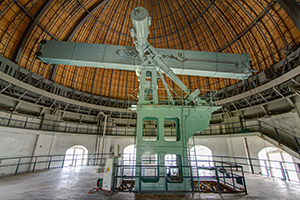
Because of their location often close to major cities and their limited separating power, today these large astronomical glasses of other age are relegated to additional tasks in favor of large telescopes mirror. In California, some 80 km south of Pasadena is one of the most prestigious telescopes in the world, which for a long time remained unrivaled: the 5-meter diameter Hale telescope on Mount Palomar. This very impressive instrument makes it possible to explore the depths of the Universe with such a resolution that it served as a model for the largest telescopes of today: the BTA-6, Magellan and MMT (~ 6 m in diameter), the VLTs, Gemini and Subaru (~ 8 m diameter), Keck (9.8 m diameter) and GTC (10.4 m diameter), and telescopes four times larger in a few years!
But a sign of progress and of necessity, for more than half a century, no astronomer has any more eyes on the eyepiece of these giant telescopes, which in any case are not equipped for this purpose, the large CCD sensor like a suitcase that has replaced the eyepiece for a few decades now. Only telescopes 1 to 2 m in diameter and large astronomical glasses over one meter in diameter are still equipped with an eyepiece and a guide bezel. But their use becomes anecdotal.
663 comments
Il game show Crazy Time è sicuramente il game show più giocati nei casinò online. Prodotto da Evolution, viene trasmesso in diretta dal 2020 e unisce una grande ruota colorata e quattro bonus round speciali: Pachinko, Cash Hunt, Coin Flip e il bonus Crazy Time.
La meccanica è semplice: un presentatore gira la ruota, si punta su uno dei quattro numeri e sui round bonus. A ogni spin il meccanismo Top Slot può aggiungere un moltiplicatore le vincite fino a 50x. Il payout teorico si colloca intorno al 95% in base al segmento.
Dall’Italia è possibile giocare solo tramite operatori ADM, con un tavolo in lingua italiana. Le puntate partono da 10 centesimi fino a 1.000 euro al tavolo italiano.
Per saperne di più su regole, statistiche e bonus per chi gioca dall’Italia, rimandiamo a guida crazy time che contiene analisi dettagliate, spiegazioni su RTP e probabilità e informazioni sul gioco responsabile.
Crazy Time è sicuramente il game show più giocati tra i giocatori italiani. Prodotto da Evolution, viene trasmesso in diretta ormai da diversi anni combinando una ruota da 54 spicchi e quattro bonus round speciali: Coin Flip, Pachinko, Cash Hunt e il Crazy Time round.
Il funzionamento è intuitivo: il conduttore fa girare la ruota, si punta su uno dei quattro numeri oppure sui bonus. Ad ogni giro il meccanismo Top Slot può aggiungere un moltiplicatore i premi fino a 50 volte. Il ritorno al giocatore teorico oscilla fra 94% e 96% a seconda della puntata.
Dall’Italia si può giocare esclusivamente su casinò con licenza ADM, con un tavolo in lingua italiana. I limiti vanno da 0,10 € a 1.000 € al tavolo italiano.
Per una guida completa su regole, statistiche e bonus in Italia, si può consultare crazy time come vincere dove trovate dati reali sulle uscite, guide su probabilità e frequenze oltre a consigli sul gioco consapevole.
Crazy Time di Evolution è sicuramente il giochi live più seguiti nel mondo del casinò live. Prodotto da Evolution, il gioco è in onda dal 2020 mescolando una grande ruota colorata a quattro giochi bonus: Cash Hunt, Coin Flip, Pachinko e il round finale Crazy Time.
La meccanica è semplice: il conduttore fa girare la ruota, si punta sui numeri 1, 2, 5 o 10 o su una delle caselle bonus. A ogni spin la doppia bobina Top Slot moltiplica i premi fino a 50 volte. Il ritorno al giocatore teorico si colloca intorno al 95% a seconda dell’esito scelto.
Per i giocatori italiani è possibile giocare solo tramite operatori ADM, e dal 2024 esiste un tavolo italiano dedicato. I limiti di puntata vanno da 0,10 € a 1.000 € sui tavoli italiani.
Per una guida completa sul funzionamento del gioco per chi gioca dall’Italia, si può consultare crazy time come funziona con statistiche aggiornate, approfondimenti su RTP e vincita massima e risorse per il gioco responsabile.
https://canadexiarx.com/# canadian pharmacy official website
online medicine shopping reputable indian online pharmacy buy medications from india
pharmacy in mexico that ships to us: buy drugs online – best mexican pharmacy online
prescriptions from mexico: online mexican pharmacy – legit mexican pharmacy
https://canadexiarx.com/# canadian drug pharmacy
https://deccanbatchrx.com/# rx india
mexican pharmacy online medications: cheap mexican rx mail order – farmacia mexicana en linea