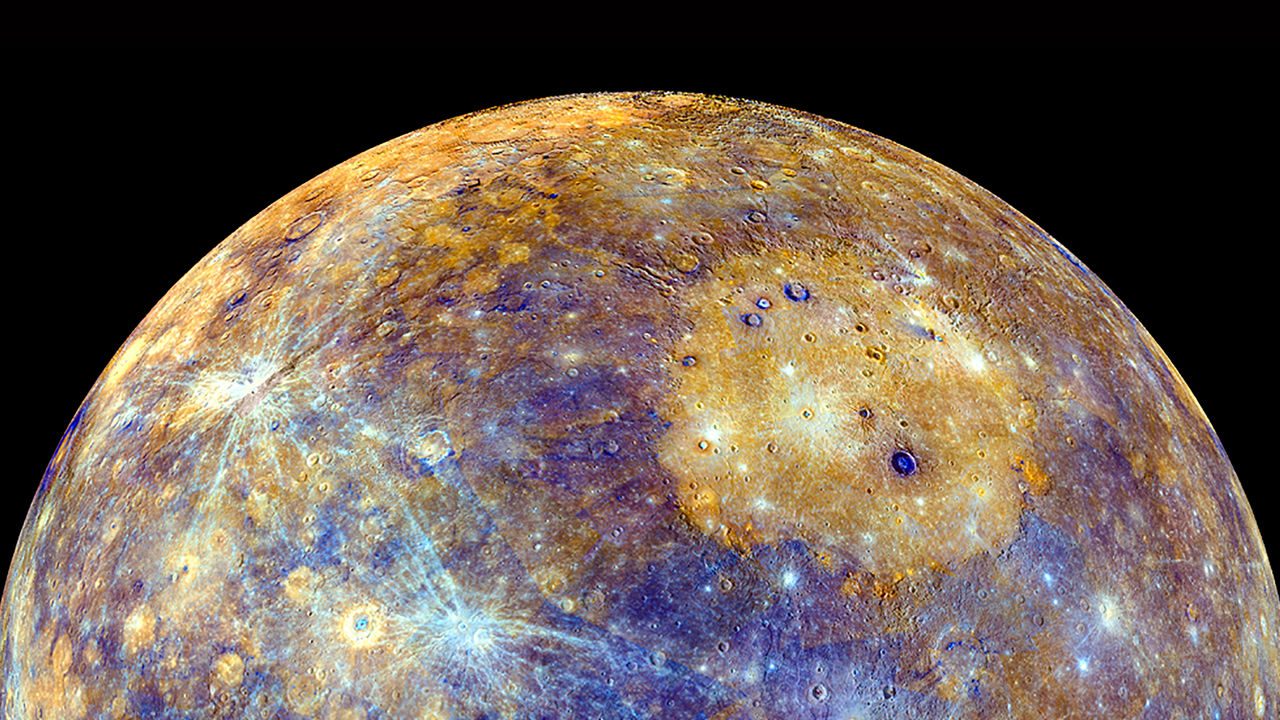
Mercury is the closest planet to the Sun. It orbits 58 million kilometers from the Sun, 2.7 times closer than the Earth and named “Swift Planet” because of it’s swiftness around the Sun.
Mercury is a small planet that resembles the Moon with a diameter of 4878 km (against 12756 km for the Earth). Mercury does not have an atmosphere. Because of this and being close to the Sun, at noon against the Sun, the average ground temperature is 169°C but can locally reach 430°C, higher than that of a full power oven, while on the dark side the temperature dives between -170 and -193°C, more icy than in Antarctica!
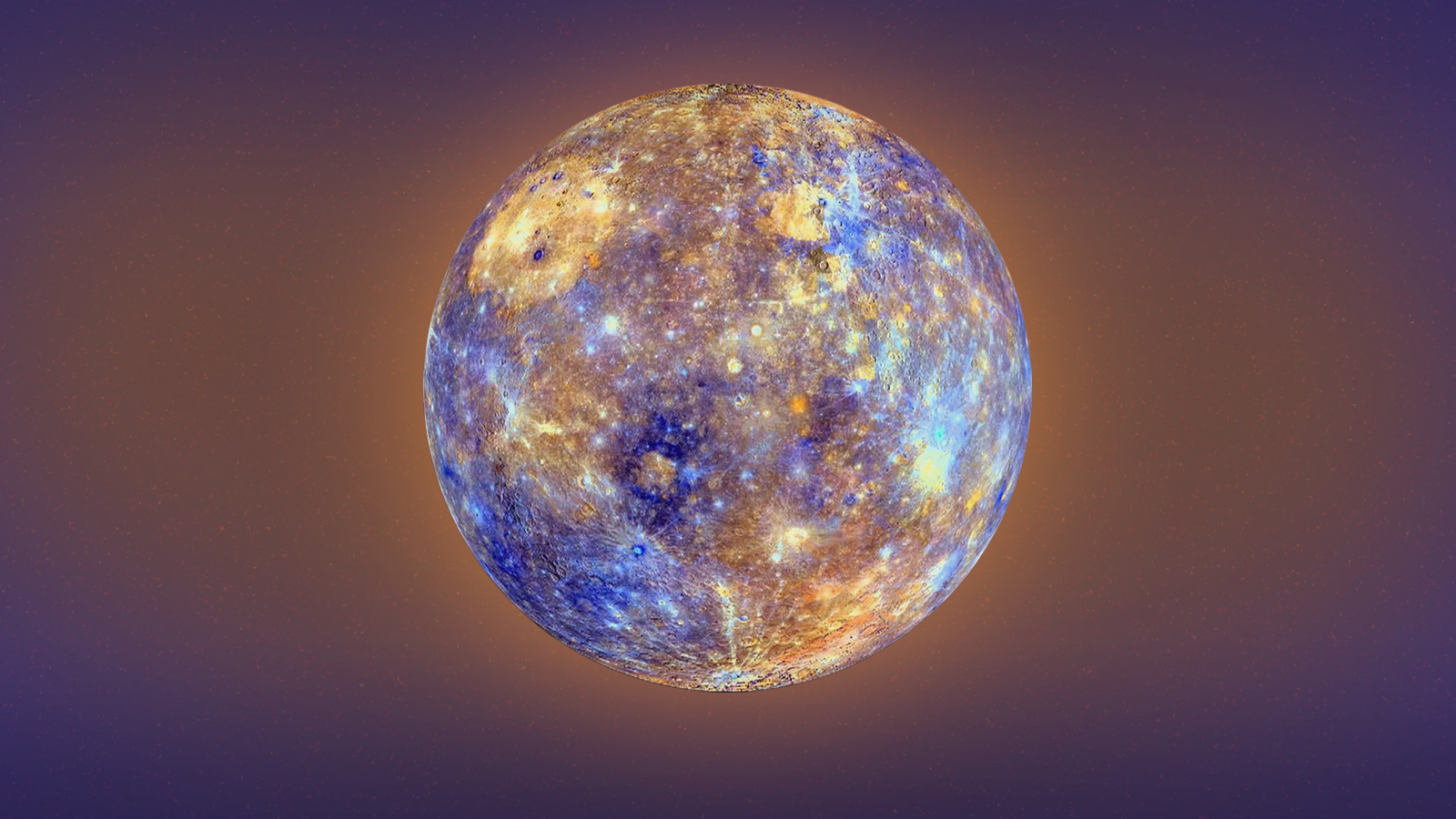
Its surface is covered with craters, mountain ranges and fractures. On Mercury we find the same formations as on the Moon, the same “ray” craters composed of debris or having a central peak, young craters and other very old ones, often covered by other craters. The largest mountains peak at about 3000 m while the faults can extend for 550 km.
The surface of Mercury contains only two large formations: the Rembrandt crater, which measures 700 km in diameter, and the Caloris basin, which stretches over 1300 km. Otherwise, the average crater size is less than 20 km.
Being very close to the Sun, Mercury goes around the Sun in 88 days (against 365.25 days for the Earth) and turns on itself in 58.6 days. In other words, combined with its rotation around the Sun, if a cosmonaut went on Mercury equipped with a special suit protecting him from the heat, he would find that the days last twice as long as the year, ie 176 days against 24 hours on earth !
Like Venus, during inferior conjunctions, that is, when Mercury is near the point closest to Earth’s orbit, it can occasionally cross the Sun’s disk. This event is called a transit. They occur every 6 to 10 years.
The last transits of Mercury in front of the Sun occurred on November 8, 2006 and May 9, 2016. The next transits will take place on November 11, 2019 and November 13, 2032.
Finally, like Venus, since it is close enough to Earth, Mercury appears as a bright star in the morning sky or in the evening near the eastern (morning) or western (evening) horizon. While being brighter than the stars, it remains less brilliant than Venus and one can easily observe its disc more or less round or crescent-shaped in an astronomical telescope or a small telescope.
332 comments
canadian pharmacy drugs online canadian pharmacies that ship to usa cipa canada online pharmacy
https://botica24.shop/# mexican medicine
https://pharmastash.shop/# order medicines from india to usa
the canadian pharmacy legit canadian online pharmacy canada pharmacy world
https://vesperarx.com/# canadian pharmacy reviews
mexican rx: farmacia pharmacy mexico – purple pharmacy online
mexico pharmacy online free shipping: Botica 24 – mexico pharmacy order online usa
https://vesperarx.com/# canada pharmacy world
https://tadavorarx.shop/# Tadalafil Tablet
companies that offer payday loans Shift Cap everyone approved payday loan