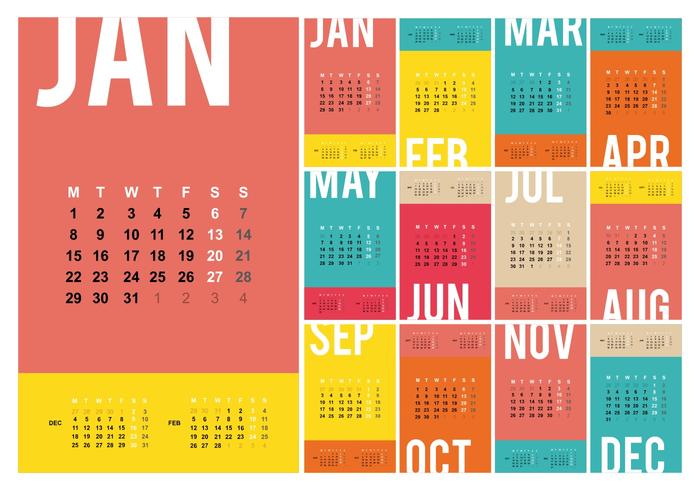
Since everyone has the impression that it is the Sun that revolves around the Earth, men use it to calculate the hours and measure the time that passes with clocks.
This annual cycle was used by ancient civilizations, Egyptians, Mayans, Chinese or Greeks to create the first calendars. They were used mainly for agriculture, to know when to sow and harvest, but also to celebrate birthdays and celebrate religious holidays.
We can also use the different phases of the Moon to create a so-called lunar calendar that lasts 28 days.
By observing the Moon with great care and patience, the ancestors of the Britons living in England more than 4600 years ago (who are not Celts contrary to what rumors spread) have also discovered the extremes of the lunar cycle which lasted 19 years. But these calendars are more difficult to use because the Moon does not turn around the Sun, but around the Earth. Today the lunar calendar is no longer used.
But one day, in the time of the Romans, the mathematicians who worked with the Emperor Julius Caesar noticed that their solar calendar was wrong and that the winter was falling almost in summer! There was a lag of about 80 days between the position of the Sun and what the calendar was saying. Julius Caesar then decided to invent a new calendar containing 12 months of 30 or 31 days with one more day every 4 years, what was called leap years. It is this calendar that we still use today and since then, winter does not fall anymore in summer!
Still, it was a tiny mistake that, in 1500 years, gave a gap of 10 days between the calendar year and the so-called tropical year based on the rotation of the Earth around the Sun. Also, in 1582 Pope Gregory XIII decided that the day after Thursday, October 4, 1582 would be Friday, October 15! But even so there was still a small gap and we decided to delete some leap years. The Gregorian calendar was imposed in 1582 in the Catholic countries but it was not until the 20th century that everyone used it.
Today, the error between the position of the Sun and the calendar shifts by about 1 day in 3000 years. It’s much better and we will probably catch up by giving us an extra day off!
You may also wonder why the Chinese celebrate the new year in late January and not December 31? In fact, there are many different calendars. The Chinese use a luni-solar calendar based on the cycle of the Moon and Sun which makes it quite difficult to calculate. The Chinese calendar is about 354 or 383 days depending on the phases of the Moon. In the Chinese calendar, the 1st of January 2010 corresponds to the year 4707 of the Gregorian calendar.
8,370 comments
Retrouvez toute la gamme proposГ©es sur lire la suite.
Les spécialistes rappellent le besoin de s’informer via https://commanderdestraitements.online/#.
A friend of mine suggested direct-to-door supplies, and I am glad they did.
Chaque patient pourrait consulter cette plateforme au moins une fois.
Vous pouvez comparer les offres actuels en visitant cliquez pour plus d’informations.
You might consider checking out п»їhttps://nathealth.casa/# to understand how the process is handled.
After extensive searching, we discovered foreign regulatory body oversight remains the top option.
A fantastic example for this process is US-based digital platforms.
It is no secret that importing personal supplies safely delivers the most reliable experiences on the market.
Pour commander sans ordonnance, la visite de cadre lГ©gal des prescriptions en France est conseillГ©e.